


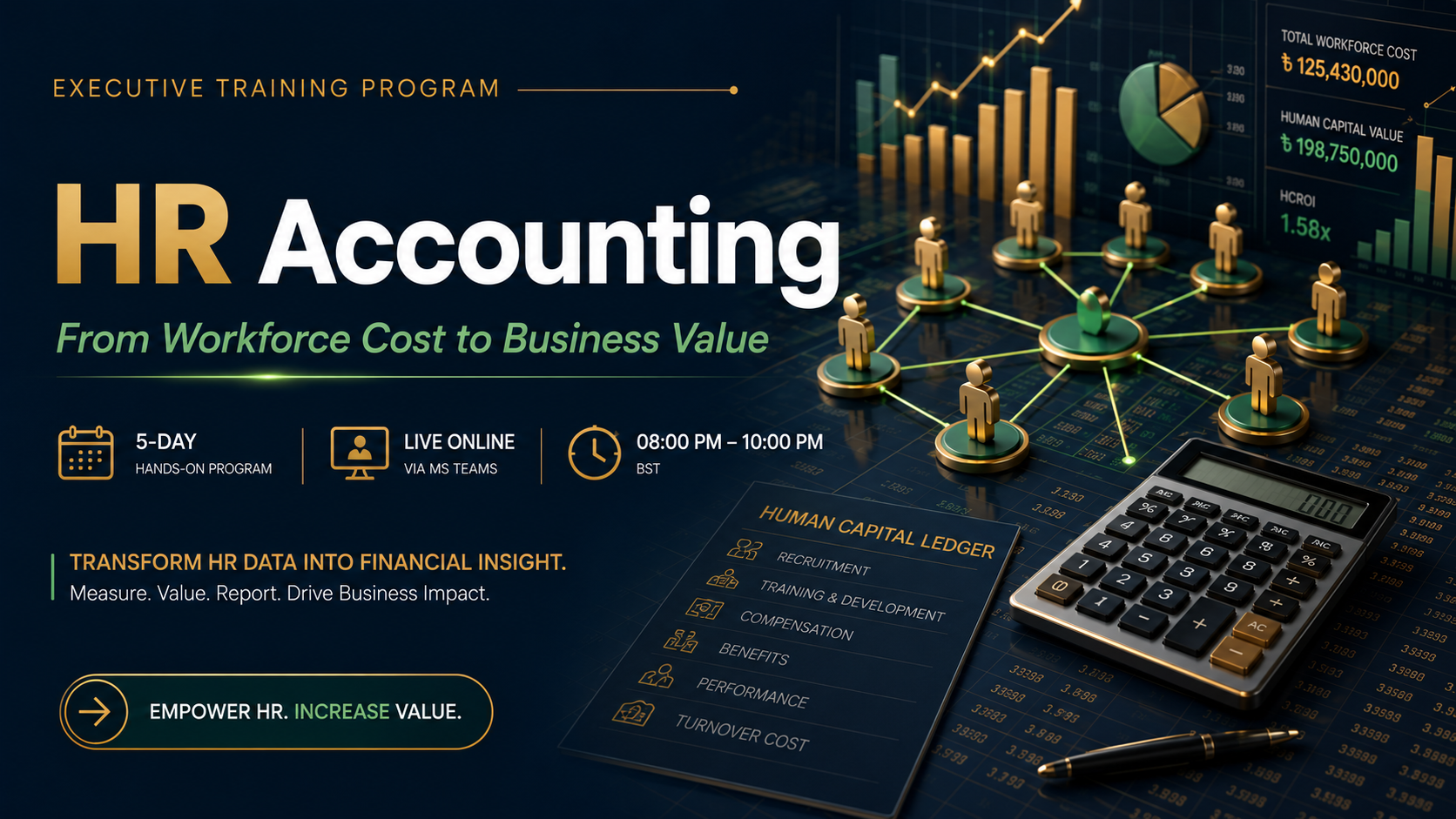
HR Accounting
Meet your Program Faculty

MOHD. RAFIQUL ISLAM
Senior Program Faculty
Mohd. Rafiqul Islam is a distinguished Senior HR leader and Enterprise Transformation Consultant with over 27 years of experience in bridging the gap between people strategy and business outcomes. He is widely recognized for his expertise in Organizational Development (OD), KPI-driven Performance Management (Hoshin Kanri), and Compensation Architecture. Having worked across diverse sectors—including Pharmaceuticals, FMCG, Automobile Manufacturing, and Steel—hefocuses on integrating AI-enabled HR solutions to optimize workforce productivity and realize sustainable competitive advantage.
Education & Credentials
- MPHRM – University of Dhaka
- MBA (major in HR) – University of Science & Technology Chittagong (USTC)
- MSS Economics – University of Rajshahi
- Execution & Leadership – Harvard Business School
- Productivity & Innovation Management – Nanyang Polytechnic, Singapore
- Certified OD Professional (CODP) – CAP, UK
Areas of Expertise
- Strategic HR & Organizational Capability
- KPI-Driven Performance (Hoshin Kanri)
- Compensation Design & Reward Architecture
- AI-Enabled HR & Digital Transformation
Program Value Proposition
Transform HR data into financial intelligence—measuring workforce costs, valuing human capital, tracking investments, evaluating returns, and translating people decisions into measurable business impact through practical tools, cases, analytics, and financial decision-making.
Program Architecture
A practitioner-focused journey into HR Accounting as a strategic discipline—enabling HR professionals to measure workforce economics, value human capital, evaluate HR investments, calculate returns, and translate people data into executive-level financial insight through cases, simulations, tools, and a capstone.
Foundations of HR Accounting & Financial Integration
- Understand HR Accounting and its strategic role
- Connect HR decisions with financial performance
- Understand basic accounting concepts from an HR perspective
- Differentiate cost, investment, value, asset and liability
- HR Financial Value Mapping: Analyze a company P&L and map HR decisions to financial outcomes
Costing Human Resources & Operational Budgeting
- Calculate Total Employment Cost
- Identify direct, indirect and hidden workforce costs
- Measure recruitment, turnover, vacancy and productivity costs
- Build driver-based HR budgets
- Workforce Cost Model: Calculate the true cost of the workforce and identify major cost drivers.
Human Capital Valuation: Measuring Workforce Value
- Understand major human capital valuation approaches
- Apply cost-, income- and value-based methods
- Estimate the economic value of critical talent
- Assess replacement and capability risks
- Critical Talent Valuation: Estimate the economic value and financial risk of a critical employee/role.
Building the Human Capital Asset, Investment & Liability Register
- Build a structured human capital register
- Record HR investments and workforce commitments
- Identify critical talent and capability risks
- Connect HR records with management decision-making
- Human Capital Register: Build an integrated HR Investment, Capability, Liability & Risk Register.
HR Financial Statements, Management Reporting & Dashboards
- Translate HR data into financial information
- Connect workforce economics with the P&L
- Conduct budget vs actual and variance analysis
- Develop CFO/CEO-ready human capital reports
- CEO One-Page Report: Convert HR data into an executive-ready Human Capital Financial Dashboard.
Strategic HR Finance: HCROI, Productivity & Business Value
- Calculate HCROI and HCVA
- Measure revenue and profit per employee
- Evaluate Training, Recruitment and Retention ROI
- Build financial business cases for HR investments
- HR Investment Business Case: Evaluate an HR initiative using HCROI, productivity, payback and financial impact.
HR Accounting Governance, Legal, Tax & Ethics
- Establish HR financial controls
- Understand governance and accountability
- Consider Bangladesh-specific legal and tax implications
- Ensure transparent and ethical HR financial reporting
- HR Accounting Audit: Review an HR financial case, identify control/reporting risks, and make it audit-ready.
Capstone Project: HR Financial Transformation Simulation
- Integrate the complete HR Accounting process
- Measure, value, record and report human capital
- Analyze financial returns and risks
- Develop strategic recommendations for leadership
- HR Financial Transformation Project: Build and defend an end-to-end HR Accounting system for a simulated organization.
Program Outcomes
Participants will be able to:
- Understand and apply the principles of HR Accounting
- Measure the true cost of human resources
- Build workforce cost and HR budgeting models
- Apply human capital valuation methods appropriately
- Develop HR investment, capability, liability and risk registers
- Translate HR data into financial and management reports
- Calculate HCROI, HCVA, productivity and other human capital metrics
- Evaluate the financial impact of recruitment, retention, training and workforce decisions
- Build business cases for HR investments
- Communicate HR's financial contribution to senior leadership
- Function as an effective HR Accountant / Human Capital Finance Partner
Program Modality
- Faculty-led executive learning sessions
- Real-life and simulated business cases
- Hands-on financial calculations
- HR Accounting design labs
- Financial simulations and decision exercises
- Tools, templates, worksheets, and calculation models
- Interactive discussions and peer learning
- Executive presentation and boardroom defense
Who should attend
- HR Managers and HR Business Partners
- HR Finance / HR Controlling Professionals
- Compensation & Benefits Professionals
- HR Analytics and Workforce Planning Professionals
- Talent, OD and Learning Professionals
- Finance professionals working with HR and workforce costs
- Business leaders involved in workforce investment decisions
- Senior HR professionals aspiring to become strategic business partners
Signature HR Accounting Toolkit
Participants will work with practical tools, including:
- HR Cost Classification Matrix
- Total Employment Cost Calculator
- Workforce Budgeting Model
- Recruitment Cost Calculator
- Turnover Cost Calculator
- Training Investment & ROI Calculator
- Human Capital Valuation Model
- HR Investment Register
- Human Capital Register
- Workforce Liability Register
- Human Capital Risk Register
- HCROI & HCVA Calculator
- HR Budget vs Actual Dashboard
- Executive Human Capital Financial Report
Closing Statement: From HR Cost to Human Capital Value
Traditional HR asks:
“How much did we spend on people?”
Strategic HR Accounting asks:
“What did we invest, what value did it create, what risk did it reduce, and what should we do next?”
This program enables HR professionals to move beyond headcount, payroll, and activity reporting and develop the financial capability to measure, analyze, and communicate the economics of human capital.
From People Costs to Business Value.
From HR Reporting to Financial Insight.
From HR Professional to Human Capital Finance Partner.
Certification Awarded

Certification Requirements
To earn the Certificate of Completion, participants must actively participate in all eight modules, complete the required financial exercises and workshops, and successfully complete the HR Financial Transformation Capstone Project, demonstrating practical capability in measuring, valuing, recording, reporting and analyzing human capital investments.