
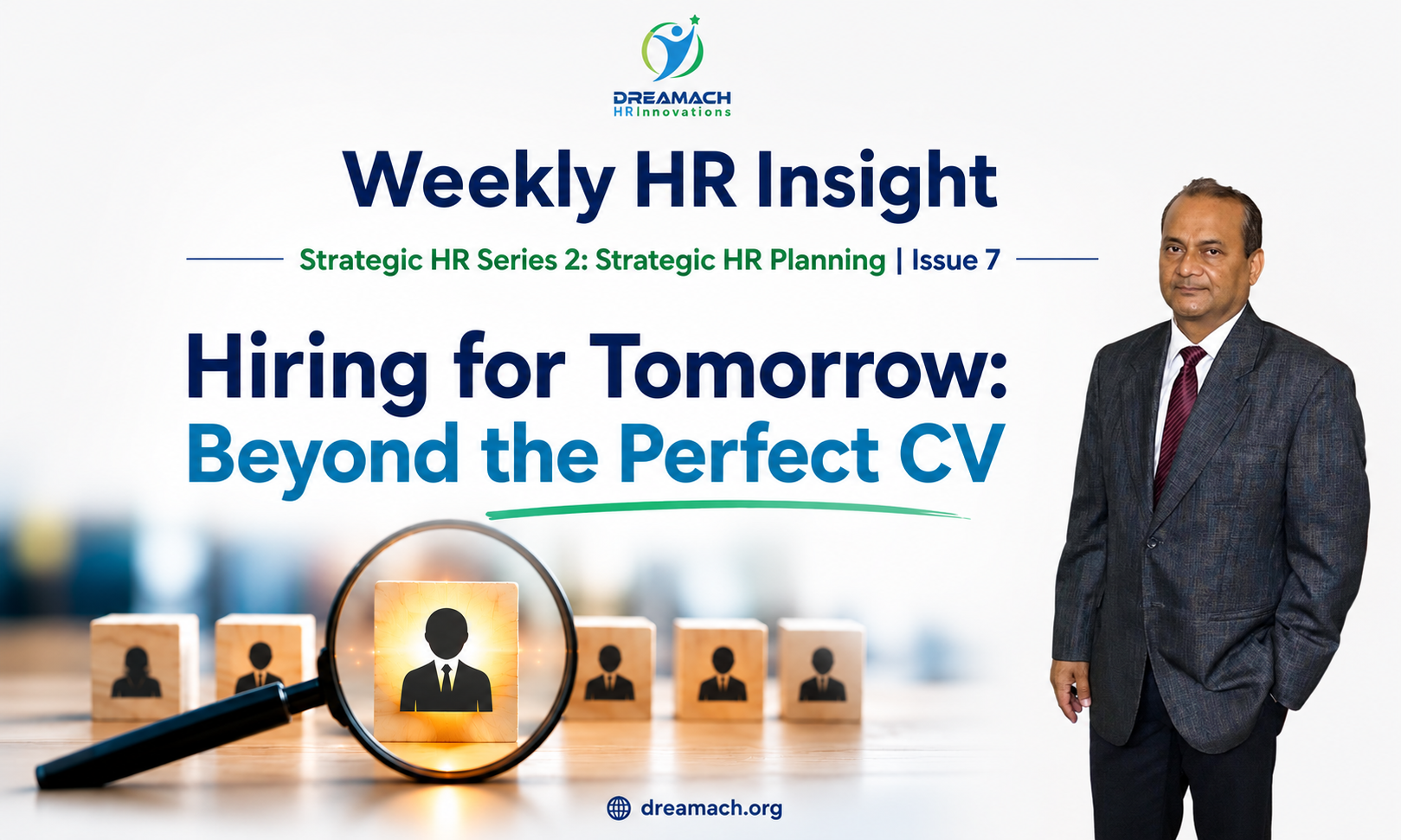
The Hiring Trap Organizations fall into
Most recruitment decisions are driven by urgency.
A role opens. A job description is pulled out. CVs are screened. The “best-fit” candidate is hired.
On paper, it works.
In reality, problems begin to surface within months:
- New hires struggle beyond defined tasks
- Adaptability is low when roles evolve
- High turnover in critical positions
The issue is not talent availability—it is how organizations define “fit.”
The real question is:
Are you hiring for today’s job—or tomorrow’s potential?
Pillar 1: Redefining What ‘Good Talent’ Means
Most hiring decisions prioritize experience and technical match.
Traditional HR: Hire based on past roles and qualifications
Strategic HR: Hire based on learning ability, adaptability, and growth potential
Why it matters:
Roles evolve faster than job descriptions.
Shift:
From experience-based hiring → potential-based hiring
Because what a candidate can become is often more valuable than what they have done.
Pillar 2: Aligning Recruitment with Business Direction
Recruitment often operates independently of future strategy.
Example:
- Growth strategy requires agile thinkers
- Digital transformation requires learning agility
- Expansion requires leadership pipeline
Common Gap:
Candidates are selected for current stability, not future needs
Shift:
From role-based hiring → strategy-aligned talent acquisition
HR must ask:
Will this person grow with the business?
Pillar 3: Designing Assessment for Potential
Traditional interviews are designed to validate experience—not uncover potential.
To assess potential, organizations must evaluate:
- Problem-solving ability
- Learning agility
- Behavioral adaptability
- Mindset and attitude
Traditional Approach: CV screening + structured interviews
Strategic Approach: Scenario-based assessments + behavioral insights
Shift:
From validation → prediction
Because past performance shows capability—but potential shows trajectory.
Pillar 4: Building a Future Talent Pipeline
Reactive hiring creates dependency on the external market.
Strategic organizations:
- Build talent pipelines proactively
- Invest in early-career hiring
- Identify high-potential candidates early
Traditional Model: Vacancy-driven hiring
Strategic Model: Pipeline-driven recruitment
Shift:
From reactive hiring → proactive talent building
Because the best talent is rarely available when you need it.
Case Insight (Bangladesh Context)
A growing FMCG company in Bangladesh faced repeated challenges in mid-level management hiring.
HR approach included:
Hiring experienced candidates from competitors
- Offering competitive salaries
- Fast-tracking onboarding
However:
- Cultural misfit increased
- Adaptability to company systems was low
- Attrition remained high
The issue was not capability—it was potential alignment.
After shifting recruitment strategy:
- Focus moved to high-potential candidates with strong learning agility
- Assessment centers introduced for problem-solving and adaptability
- Internal talent pipeline strengthened through graduate hiring programs
- Hiring managers trained to assess mindset, not just experience
Within 12 months:
Retention improved significantly
- Internal promotions increased
- Leadership pipeline became stronger
Lesson:
Hiring for potential builds sustainability—hiring for experience solves short-term gaps.
Management Tip
In your next hiring decision, allocate at least 40% weight to potential indicators (learning ability, adaptability, mindset)—not just experience.
Leadership Question
Are your hiring decisions optimizing immediate performance—or building future leadership?
Closing Thought
Recruitment is no longer about filling positions—it is about shaping the future of the organization.
The most successful companies do not just hire talent.
They invest in potential that grows with their strategy.
Because in a fast-changing business environment, the ability to learn will always outperform the ability to repeat.
Read. Apply. Transform.
Are you hiring for the job—or for the future?
References
- Fernández-Aráoz, C. (2014). 21st-Century Talent Spotting
- Cappelli, P. (2008). Talent on Demand
- Ulrich, D. et al. (2012). HR from the Outside In
Comments
No comments yet. Be the first to comment!
Add Comment