
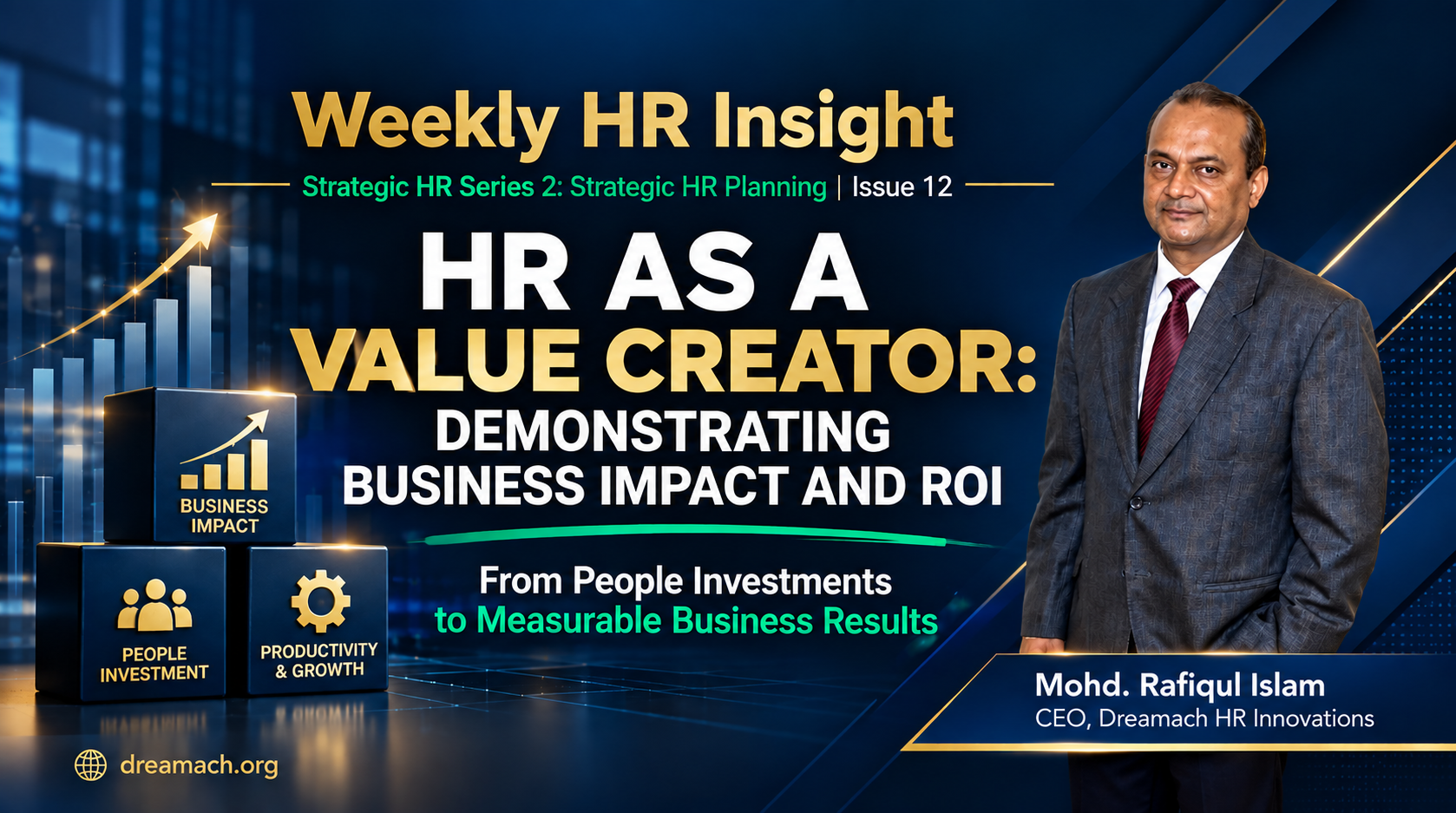
Opening: From HR Activity to Business Value
HR teams are busy.
Recruitment is happening. Training calendars are full. Performance reviews are completed. Engagement initiatives are launched. HR dashboards contain dozens of metrics.
Yet when the CEO asks, “What business value did these HR investments create?”, the answer is often unclear.
This is one of the biggest gaps in strategic HR practice: measuring HR activity instead of measuring business impact.
The strategic question is no longer “What did HR do?”
It is:
“What changed in the business because HR did it?”
Four Strategic Pillars
Pillar 1: Start with Business Outcomes
HR value begins with the business strategy—not the HR calendar.
If the business wants higher productivity, faster growth, lower operating cost, better customer service, or stronger quality, HR must identify how workforce decisions can influence those outcomes.
Before: HR initiative → HR activity → HR report
After: Business goal → Workforce lever → HR intervention → Business outcome
This shifts HR from being a service provider to becoming a contributor to business performance.
Pillar 2: Measure the Value of Workforce Investments
Every major HR investment should have a value hypothesis.
For example:
Training investment → improved capability → better productivity → financial impact
Critical-role recruitment → faster deployment → reduced operational loss
Performance management → clearer priorities → improved execution
The objective is not to force every HR activity into a financial formula. It is to identify where workforce investments can reasonably influence measurable business outcomes.
Pillar 3: Connect HR Metrics with Business Metrics
HR metrics become powerful when they connect to operational and financial measures.
Consider:
- Time-to-fill → vacancy cost / operational continuity
- Training effectiveness → productivity / quality improvement
- Turnover → replacement cost / capability loss
- Workforce productivity → revenue or output per employee
- Critical-role coverage → business continuity
Before: HR dashboard and business dashboard operate separately.
After: Workforce metrics explain movements in business performance.
That is where HR analytics becomes strategic.
Pillar 4: Build an HR Value Chain
HR should demonstrate the pathway from intervention to impact.
A useful value chain is:
HR Investment → Workforce Change → Behaviour/Capability → Operational Result → Financial Impact
For example, a leadership-development program should not end with “95 managers trained.”
The stronger question is:
Did managerial capability improve, did team performance change, and did that improvement contribute to measurable business results?
This creates a much stronger business case for HR.
Case Insight: A Bangladesh FMCG Company
A growing FMCG company was facing declining salesforce productivity.
HR responded initially with more recruitment and additional training.
But the problem persisted.
A deeper workforce analysis showed that the issue was not simply headcount or training. Sales roles had unclear performance expectations, uneven territory productivity, and limited linkage between performance and rewards.
HR redesigned the intervention around role clarity, KPI-driven performance management, capability building, and incentive alignment.
Instead of reporting only recruitment numbers and training hours, HR began tracking sales productivity, target achievement, turnover, and incentive effectiveness.
The conversation with management changed—from “What did HR spend?” to “What business problem did the workforce intervention solve?”
That is the beginning of HR as a value creator.
Management Tip
For every major HR initiative, complete this five-question test:
What business problem are we solving?
What workforce factor influences it?
What will HR change?
Which business metric should move?
How will we measure the impact?
If these five questions cannot be answered, the initiative may not yet have a clear business case.
Leadership Question
If your HR budget were treated as a business investment rather than an expense, could you demonstrate the value it creates?
Closing Thought
Strategic HR is not about proving that HR is important.
It is about demonstrating how people, capabilities, and workforce decisions contribute to business performance.
The future of HR belongs to leaders who can connect people investment with business outcomes—not through impressive activity reports, but through credible evidence of value.
When HR can speak the language of business impact, it earns a stronger voice in business decisions.
Read. Apply. Transform.
References
- Becker, B. E., Huselid, M. A., & Ulrich, D. (2001). The HR Scorecard: Linking People, Strategy, and Performance.
- Fitz-enz, J. (2000). The ROI of Human Capital.
- Kaplan, R. S., & Norton, D. P. (1996). The Balanced Scorecard: Translating Strategy into Action.
Comments
No comments yet. Be the first to comment!
Add Comment