
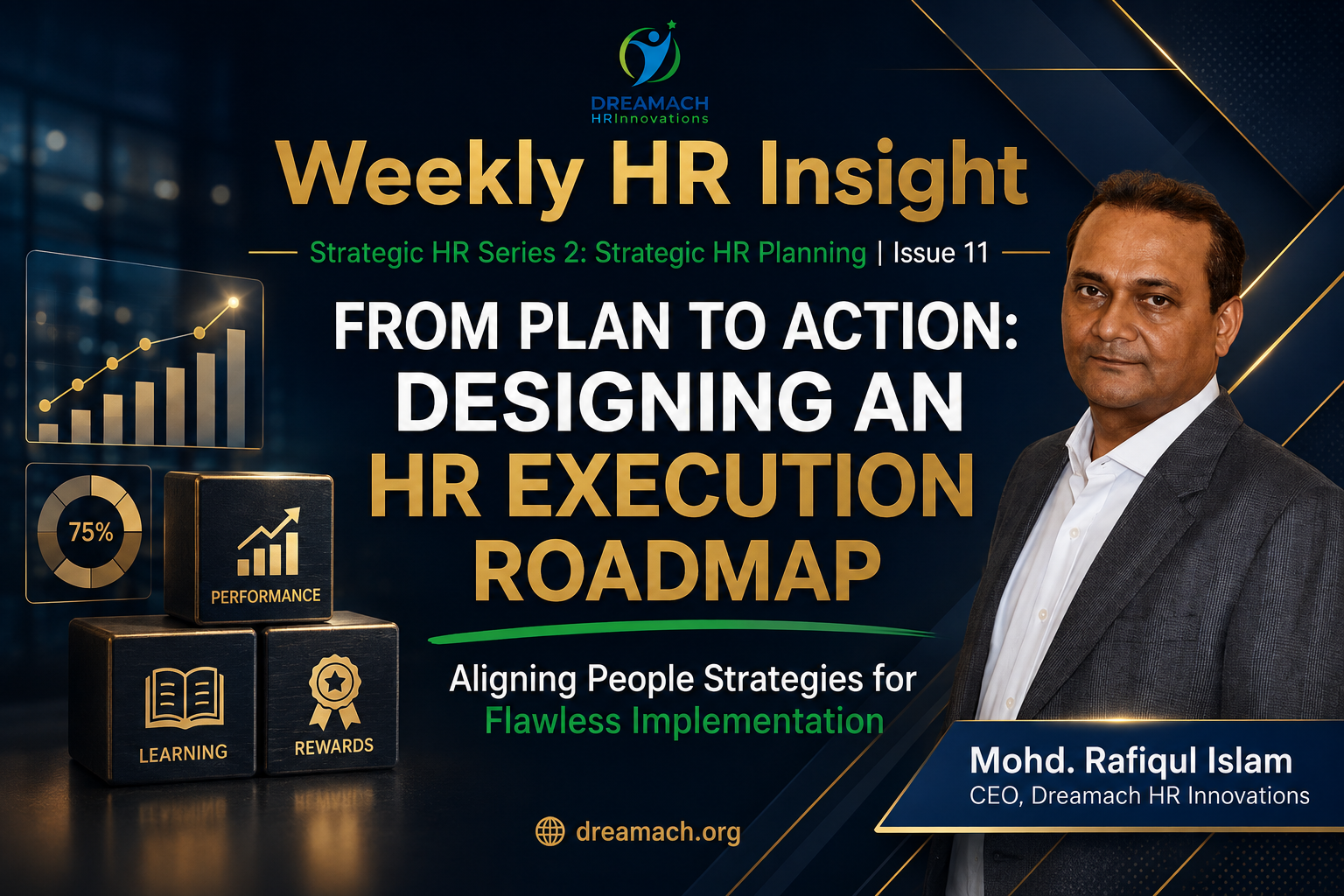
The Execution Gap
Many organizations have an HR plan.
They have manpower budgets, recruitment plans, training calendars, succession lists, and performance targets.
Yet when business priorities change, HR often struggles to respond quickly.
The problem is not always the quality of the HR plan. The bigger problem is the gap between planning and execution.
A business may decide to expand into a new market, increase production, introduce automation, or improve customer service. But does HR have a clear roadmap showing what workforce capabilities are needed, when they are needed, who owns the action, and how progress will be measured?
Strategic HR planning becomes valuable only when the plan moves people, capabilities, and decisions into action.
Four Strategic Pillars
Pillar 1: Convert Business Priorities into Workforce Actions
HR should not start with, “How many people do we need?”
Start with, “What must the business achieve?”
Translate strategic priorities into workforce requirements—critical roles, capabilities, headcount, productivity, and leadership capacity.
Before: Business strategy → HR manpower plan
After: Business strategy → Workforce requirements → HR actions
This makes HR planning a business execution tool rather than an annual manpower exercise.
Pillar 2: Prioritize Critical Workforce Gaps
Not every workforce gap deserves the same attention.
Identify the roles and capabilities that can significantly influence business performance. Then assess the gap between current capability and future requirement.
For example, business expansion may require stronger sales leadership, supply-chain capability, technical skills, or frontline productivity.
The question changes from:
“Where do we need more people?”
to:
“Which workforce gaps could prevent us from achieving the strategy?”
That is a strategic shift in HR planning.
Pillar 3: Build One Integrated Execution System
Recruitment, learning, succession, performance management, rewards, and workforce deployment should not operate as separate HR initiatives.
They should connect to the same workforce priorities.
For a critical capability gap:
Identify → Build/Buy → Deploy → Measure → Improve
Before: Multiple HR initiatives running independently
After: One connected workforce execution system
This creates consistency between workforce planning and capability building.
Pillar 4: Establish Ownership, Milestones and Business Measures
A plan without ownership becomes a document.
Every strategic HR action should have:
- A clear owner
- A defined timeline
- Measurable milestones
- Required resources
- A business outcome
HR should report not only “training completed” or “positions filled,” but whether those actions improved productivity, reduced critical-role gaps, strengthened capability, or supported business growth.
Execution creates credibility.
Case Insight: A Bangladesh Manufacturing Company
A local manufacturing company planned a significant production expansion.
Initially, HR responded by preparing a recruitment plan based mainly on projected headcount.
But the business needed more than additional employees. It needed experienced production supervisors, stronger maintenance capability, and leaders capable of managing a larger operation.
HR shifted from headcount planning to execution-roadmap planning.
Critical roles were identified, capability gaps were assessed, recruitment and internal development were sequenced, and milestones were aligned with the production expansion timeline.
The result was better workforce readiness, fewer last-minute hiring pressures, and stronger alignment between HR actions and operational requirements.
The lesson: workforce planning becomes strategic when it is designed around business timing—not simply employee numbers.
Management Tip
For every major business priority, create a one-page HR Execution Roadmap showing:
Business Priority → Workforce Need → Critical Gap → HR Action → Owner → Timeline → Business Measure
If the connection cannot be clearly shown, the HR plan is probably not ready for execution.
Leadership Question
Is your HR plan designed to predict workforce needs—or to ensure the business is actually ready to execute its strategy?
Closing Thought
Strategic HR planning should not end when the plan is approved.
That is where execution begins.
The strongest HR teams do not simply forecast workforce requirements. They build a practical roadmap that connects business strategy, workforce planning, capability building, and measurable execution.
Because ultimately, the value of an HR plan is not in how well it is written.
It is in how effectively it helps the business move forward.
Read. Apply. Transform.
Is your HR plan truly driving business execution—or simply documenting what HR intends to do?
References
- Porter, M. E. (1985). Competitive Advantage: Creating and Sustaining Superior Performance.
- Becker, B. E., Huselid, M. A., & Ulrich, D. (2001). The HR Scorecard.
- Ulrich, D. (1997). Human Resource Champions.
Comments
No comments yet. Be the first to comment!
Add Comment